Language
 English
 русский
 Español

Get A Quote
Get A Quote
 2026.03.24
 Industry News
The fundamental difference between a 2-phase (single-phase) and a 3-phase welding machine lies in how they draw electrical power from the grid. A 2-phase (or single-phase) welding machine uses two conductors — one live and one neutral — and draws power in a single alternating wave. A 3-phase welding machine uses three live conductors with power delivered in three overlapping waves, resulting in a smoother, more continuous energy supply.
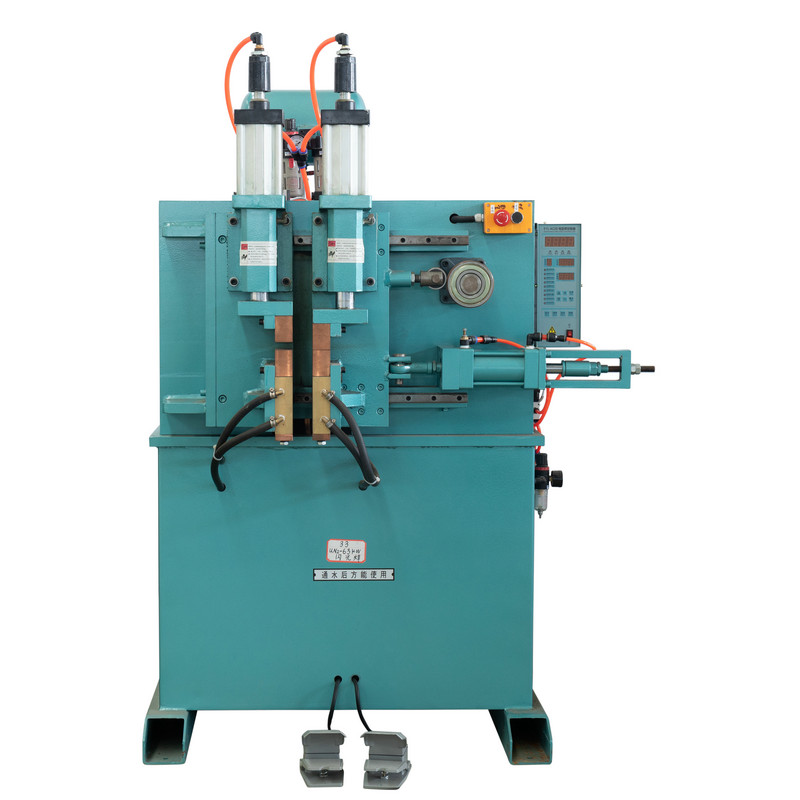
In practical terms: 3-phase machines deliver more consistent power, higher efficiency, and are better suited for heavy industrial welding tasks, while 2-phase machines are simpler, cheaper, and more accessible for smaller workshops or light-duty applications. For demanding operations like wire butt welding, a Two-Stage Discharge Pneumatic Butt Welding Machine typically relies on robust power systems precisely because consistent current delivery is critical.
To understand why phase count matters, consider how alternating current (AC) behaves. In a single-phase system, voltage rises and falls in one wave cycle — this creates brief moments where power output drops to near zero. In a three-phase system, three waves are offset by 120° from each other, so at any moment at least one wave is near peak output.
For welding, this distinction is highly relevant. Inconsistent power delivery leads to arc instability, uneven bead profiles, and weaker joints. A 3-phase supply minimizes these fluctuations, which is why high-output industrial welders — including resistance welding and pneumatic butt welding equipment — are almost exclusively powered by three-phase circuits.
The table below summarizes the most important technical differences between 2-phase and 3-phase welding machines:
| Feature | 2-Phase (Single-Phase) | 3-Phase |
|---|---|---|
| Power Supply | 230V / 1-phase | 380–415V / 3-phase |
| Power Delivery | Pulsed (with zero-crossing drops) | Continuous and smooth |
| Typical Power Output | Up to ~20 kVA | 20 kVA – 600+ kVA |
| Grid Load Balancing | Unbalanced load on one phase | Balanced across all three phases |
| Energy Efficiency | Lower (~70–80%) | Higher (~85–95%) |
| Arc / Weld Stability | Moderate | High |
| Equipment Cost | Lower | Higher |
| Installation Complexity | Simple | Requires 3-phase supply |
| Best Application | Light fabrication, DIY, small shops | Industrial production, butt welding, heavy metals |
Weld quality is directly influenced by the stability and consistency of the power supply. In resistance welding and pneumatic butt welding, the machine must deliver a precise amount of energy in a very short time — often measured in milliseconds. Any fluctuation can result in:
3-phase welding machines reduce these risks significantly. In industrial tests, 3-phase resistance welders show up to 15–20% narrower HAZ compared to equivalent single-phase machines welding the same cross-section. This is particularly important when welding high-carbon steel rods, copper conductors, or stainless bars — materials that are sensitive to thermal variation.
From an energy economics perspective, 3-phase machines have a clear advantage. Because power is distributed evenly across three conductors, each wire carries less current for the same total wattage. This results in:
For a production facility running welding machines 8–16 hours per day, the difference in energy costs between a 2-phase and 3-phase system can be 10–25% annually, depending on power tariff structures and machine load cycles. Over a 5-year machine lifespan, this can represent substantial savings.
Single-phase welding machines remain practical in specific contexts. If your operation involves:
…then a 2-phase machine can be a cost-effective and practical choice. They typically cost 30–50% less upfront and require no special electrical infrastructure.
For any of the following applications, a 3-phase machine is the correct choice:
In pneumatic butt welding, where the machine must coordinate electrical discharge timing with mechanical clamping and upset force — often within ±2ms tolerance — a stable 3-phase supply is not optional, it is essential.
The internal transformer architecture differs significantly. A single-phase welding transformer uses a straightforward core with primary and secondary windings optimized for one AC cycle. A 3-phase transformer uses a three-limb or five-limb core that handles three simultaneous flux paths.
This design difference has several consequences:
For applications like pneumatic butt welding where the machine fires multiple welds per minute, a higher duty cycle directly translates to greater production throughput without machine downtime.
In industrial facilities, electrical system balance matters. Single-phase loads are inherently unbalanced — they draw current from only one phase, which can cause voltage asymmetry in the supply network. When multiple single-phase welding machines operate simultaneously, this imbalance can:
Three-phase machines distribute load evenly, making them the preferred choice in regulated industrial environments. Most national electrical codes and industrial plant regulations explicitly require 3-phase connections for welding equipment above a certain power threshold — commonly 10 kVA or higher.
Maintenance requirements differ between the two configurations in ways that affect total cost of ownership:
| Maintenance Factor | 2-Phase Machine | 3-Phase Machine |
|---|---|---|
| Transformer replacement frequency | Higher (thermal stress) | Lower (distributed heat) |
| Contactor/relay wear | Moderate | Lower (balanced switching) |
| Electrode / clamp wear | Faster (power surges) | Slower (stable delivery) |
| Cooling system demands | Higher | Lower |
| Typical overhaul interval | Every 12–18 months | Every 24–36 months |
For a production facility, this means 3-phase machines offer significantly lower maintenance costs over a 5–10 year period, even if the initial purchase price is higher.
Generally, no. The internal transformer and control circuitry of a single-phase machine are designed for single-phase input. Running it on 3-phase without a proper matching transformer would damage the equipment. A phase converter can be used to derive single-phase power from a 3-phase supply, but the reverse is not a standard or recommended practice.
Not always — it depends on the application. For light-duty or low-frequency welding, a 2-phase machine is simpler and more cost-effective. For high-volume industrial welding, especially butt welding of large cross-sections, a 3-phase machine is superior in every measurable way: stability, efficiency, duty cycle, and weld quality.
Two-stage discharge refers to a welding sequence where current is applied in two separate stages — typically a preheat phase followed by a main welding discharge. This approach allows more controlled heat input, reduces thermal shock to the workpiece, and improves the quality of the upset weld joint. It is especially beneficial when welding materials with high thermal conductivity or those prone to cracking.
Depending on the machine's rated output, 3-phase pneumatic butt welders can handle cross-sections ranging from approximately 10mm² up to 1,500mm² or more for heavy industrial models. Machines in the 150kW range are typically designed for medium-to-large cross-section applications, such as reinforcing bars, copper bus bars, and wire rope.
Check with your facility's electrical engineer or utility provider. You need a confirmed 3-phase supply at the required voltage (typically 380V or 415V), sufficient amperage capacity at the distribution panel, and proper grounding. Most industrial plants built after the 1980s already have 3-phase infrastructure in place.
The welding process itself is similar. However, operators should understand the machine's current and timing control settings, which are often more sophisticated on 3-phase industrial equipment. Basic electrical safety training specific to 3-phase systems is recommended, particularly regarding lockout/tagout procedures.
Recommended Products

Product
Contact Info.
+86-152-5712-5882
Fax: +86-563-2269966
No. 21 Guangping Road, Guangde Economic Development Zone, Guangde City, Anhui Province
QR Code