Language
 English
 русский
 Español

Get A Quote
Get A Quote
 2026.03.05
 Industry News
Spot welding is a resistance welding process that joins two or more metal sheets by applying heat and pressure at localized points. The heat is generated by passing a high electric current through the metal at the contact point, causing the material to melt and fuse together. The entire process typically takes between 0.01 and 0.63 seconds per weld, making it one of the fastest joining methods available in manufacturing.
Unlike arc welding or MIG welding, spot welding requires no filler material and produces clean, consistent welds with minimal distortion to the surrounding metal. It is widely used in industries where thin-gauge sheet metals need to be joined quickly and reliably, from automotive body panels to battery pack assembly.
The spot welding process relies on three core physical principles: electrical resistance, heat generation, and applied pressure. Here is a step-by-step breakdown of how it works:
The size and strength of each weld nugget depend on current intensity, electrode force, weld time, and electrode tip geometry. A properly formed weld nugget in standard automotive steel typically measures 4 to 8 mm in diameter.
Understanding the main components helps operators set up, maintain, and optimize the machine for different materials and applications.
| Component | Function | Key Specification |
|---|---|---|
| Transformer | Steps down voltage and steps up current for welding | Typically 5–500 kVA |
| Electrodes | Conduct current and apply pressure to the workpiece | Copper-chromium alloy, various tip diameters |
| Controller / Timer | Regulates weld time, current, and squeeze/hold cycles | Programmable, supports multi-step schedules |
| Pressure System | Applies clamping force through pneumatic or hydraulic actuator | Force range: 50–5,000 N depending on model |
| Cooling System | Prevents electrode and transformer overheating | Water-cooled circuits standard on production models |
| Pedal / Trigger | Operator input to initiate weld cycle | Foot pedal or hand trigger depending on machine type |
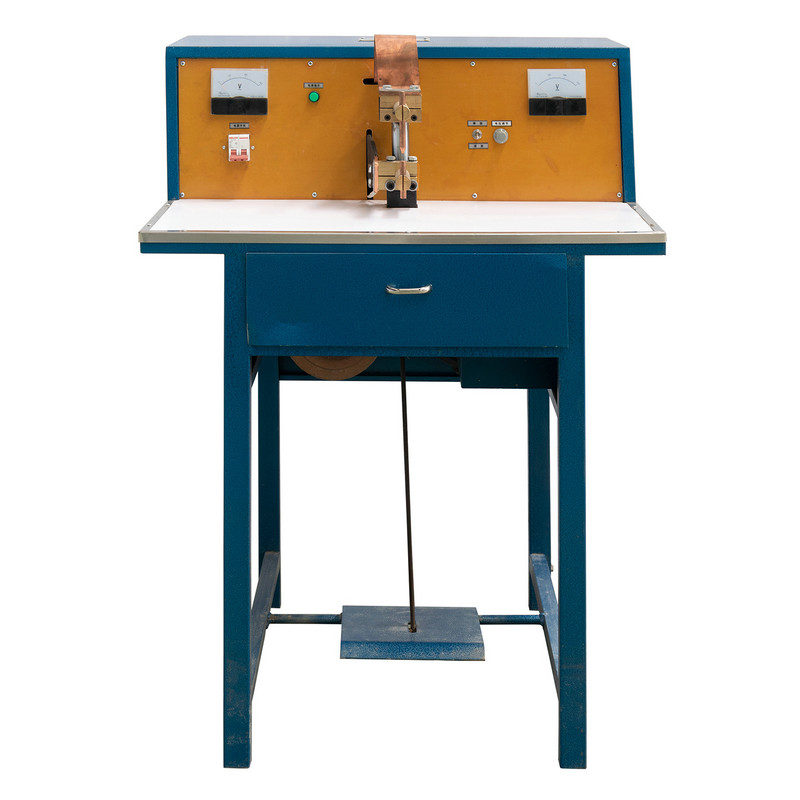
In pedal-operated spot welders, the foot pedal controls the electrode descent and triggers the weld cycle, freeing both hands to position the workpiece accurately. This is a significant ergonomic and precision advantage in high-mix or manual assembly environments.
Spot welding machines come in several configurations, each suited to different production volumes, workpiece sizes, and operator requirements.
Compact machines designed for low-to-medium volume work. They are commonly used in repair shops, electronics manufacturing, and small fabrication operations. Weld capacity typically covers materials up to 2 mm per sheet thickness.
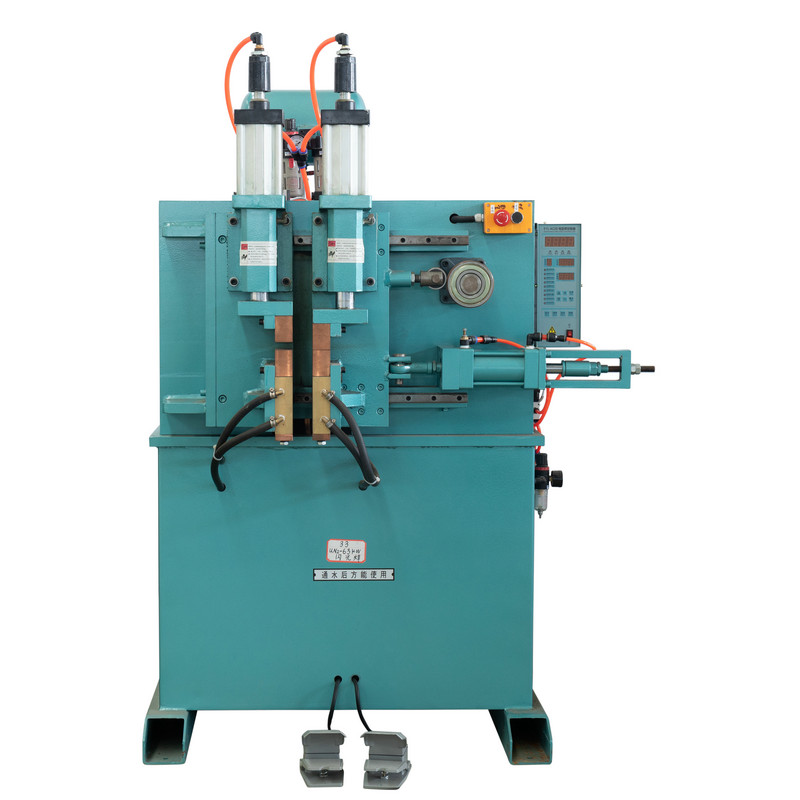
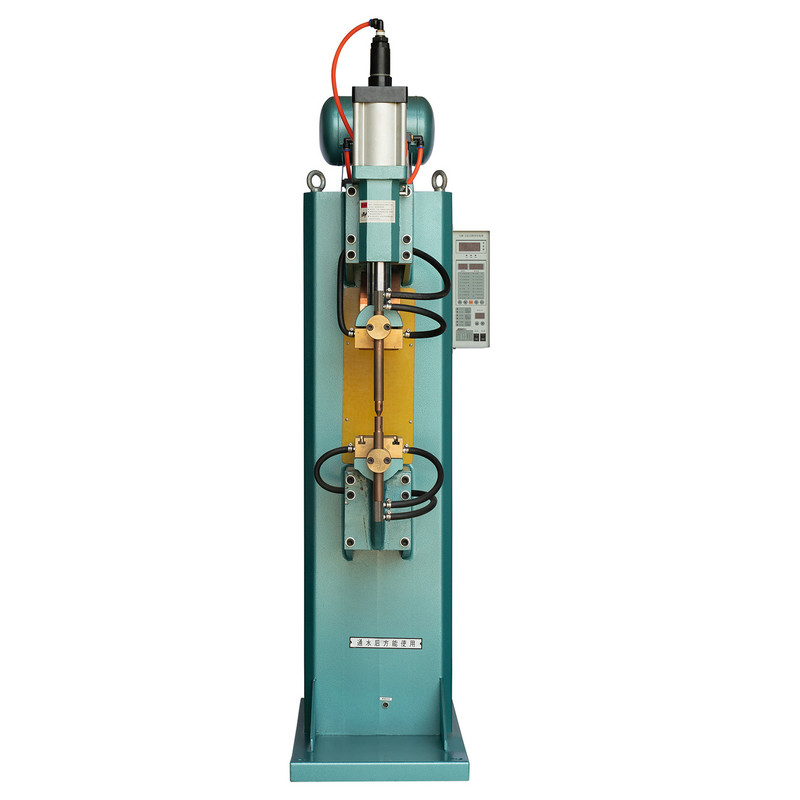
These machines use a foot pedal to trigger the electrode arm and initiate the weld cycle. The operator's hands remain free to hold and position the workpiece, which improves accuracy and repeatability. The DN Pedal Spot Welding Machine is a representative example of this category, combining robust transformer output with ergonomic foot-pedal control for consistent, operator-friendly performance in sheet metal fabrication.
High-volume production lines — particularly in automotive manufacturing — rely on robotic spot welding cells. A single robotic spot welding station can complete 400 to 600 welds per hour, making it indispensable for body-in-white assembly.
Hand-held welding guns that allow operators to reach weld points in tight or irregular geometries, often used in auto body repair and HVAC fabrication.
Spot welding is most effective on low-carbon steel and galvanized steel, which offer good electrical resistance and weldability. However, with proper machine settings and electrode selection, a wide range of metals can be joined.
Material thickness is a critical constraint. Most manual and bench-top spot welders handle sheet combinations of 0.5 mm to 3 mm per layer. Exceeding this range typically requires upgrading to a higher-kVA transformer or switching to a projection or seam welding process.
Four parameters directly control weld quality. Misadjusting any one of them leads to defects such as expulsion (splatter), insufficient fusion, or electrode sticking.
Higher current generates more heat. For 1 mm mild steel sheets, a current of approximately 8,000–10,000 A is typical. Aluminum requires 2–3 times higher current than steel of the same thickness.
Measured in cycles (1 cycle = 1/50 or 1/60 second depending on grid frequency). For thin automotive sheet steel, weld times of 8 to 20 cycles are standard. Longer times increase heat input but risk expulsion if current is not reduced accordingly.
Adequate force ensures good electrical contact and suppresses expulsion. Insufficient force causes arcing and surface burning. A general guideline is 1,500–2,500 N for standard 1–2 mm steel.
Flat-face tips produce a larger, shallower nugget; dome-face tips concentrate heat. Tips must be dressed regularly — typically every 50–200 welds — to maintain consistent contact area and weld quality.
Spot welding is used across a broad range of industries wherever thin metal sheets must be joined quickly and cleanly.
| Industry | Typical Application | Material |
|---|---|---|
| Automotive | Body-in-white panels, door skins, floor pans | Low-carbon / galvanized steel |
| Battery Manufacturing | Cell tab welding in EV and consumer battery packs | Nickel strip, copper foil |
| HVAC | Duct joints, air handler housings | Galvanized steel |
| Appliances | Washing machine drums, refrigerator cabinets | Cold-rolled steel |
| Electronics | Metal enclosures, grounding tabs | Stainless steel, mild steel |
| Sheet Metal Fabrication | Custom brackets, frames, enclosures | Various |
Choosing the right joining process depends on material type, joint design, production volume, and quality requirements. The table below compares spot welding against common alternatives.
| Method | Speed | Filler Needed | Best For | Weakness |
|---|---|---|---|---|
| Spot Welding | Very Fast | No | Sheet metal lap joints | Limited joint types |
| MIG Welding | Moderate | Yes | Thick materials, varied joints | More distortion, slower |
| TIG Welding | Slow | Optional | Precision, thin exotic metals | High skill required |
| Laser Welding | Very Fast | No | Precision thin sheet | High equipment cost |
| Riveting | Moderate | No | Dissimilar materials | Added weight, visible fasteners |
For high-volume sheet metal production, spot welding offers the best balance of speed, cost, and weld consistency among all joining options.
Highly conductive metals like pure copper and brass are very difficult to spot weld with standard equipment because they dissipate heat too quickly. Magnesium alloys and lead are also generally not suitable for spot welding.
Standard manual and pedal-operated spot welders typically handle 0.5 mm to 3 mm per sheet layer. Heavier gauges require higher-kVA machines or alternative welding processes.
Spot welds are strong in shear but relatively weak in peel. For structural applications, welds are placed in arrays of multiple spots and designed so the joint loads in shear rather than peel. Automotive body structures rely entirely on spot-welded joints for crash performance.
A pedal spot welder uses a foot pedal to control the electrode arm and trigger the weld cycle, leaving both hands free to hold and position the workpiece. A standard bench welder typically requires one hand to operate the trigger, which can reduce positioning accuracy on complex parts.
Visual inspection can detect obvious defects like surface burn, expulsion marks, or missing welds. To confirm nugget formation and pull strength, perform a destructive peel test — if the nugget tears parent metal rather than peeling cleanly at the interface, the weld meets strength requirements. Ultrasonic testing is the primary non-destructive method for production inspection.
Electrodes should be dressed (reshaped) every 50–200 welds depending on material and current settings. Full electrode replacement is needed when the tip can no longer be dressed to the correct diameter, typically after several thousand weld cycles.
Yes, but aluminum spot welding requires specialized machines with significantly higher current output (typically 2–3× steel requirements) and modified electrode materials. Standard steel spot welders are not suitable for aluminum without modification.
Recommended Products

Product
Contact Info.
+86-152-5712-5882
Fax: +86-563-2269966
No. 21 Guangping Road, Guangde Economic Development Zone, Guangde City, Anhui Province
QR Code