Language
 English
 русский
 Español

Get A Quote
Get A Quote
 2026.03.12
 Industry News
A welding foot pedal is an operator-controlled input device that connects to a welding machine and allows the welder to adjust electrical current in real time using foot pressure — without removing hands from the torch or workpiece. In essence, it functions like an accelerator pedal: press harder to increase amperage, ease off to reduce heat. This hands-free control is especially critical in TIG (GTAW) welding and precision resistance spot welding, where heat management directly determines joint quality.
The short answer: a welding foot pedal gives the operator dynamic, moment-to-moment control over welding current, dramatically improving weld quality on thin materials, heat-sensitive alloys, and complex joint geometries.
Most foot pedals operate through one of two mechanisms:
The pedal connects to the welding machine via a control cable (commonly 6-pin or 7-pin connectors for TIG machines, or proprietary connectors for resistance welders). The machine's control board interprets the signal and adjusts output within the pre-set amperage range defined by the front panel settings.
For desktop spot welding machines, the foot pedal works differently: it acts as a trigger switch that initiates the welding cycle when depressed. The operator positions the electrodes by hand, then activates the weld with a foot press — enabling precise control over electrode placement and weld timing simultaneously.
In TIG welding, heat input must be continuously modulated. Starting a weld on cold metal requires higher amperage; as the base metal heats up, amperage must drop to prevent burn-through. Without a foot pedal, the welder must preset a fixed amperage — a compromise that rarely delivers optimal results. Studies on thin stainless steel (0.5–1.5mm) show that foot pedal-controlled TIG welds reduce heat-affected zone width by up to 30% compared to fixed-amperage runs.
Welding requires both hands — one for the torch, one for filler rod. The foot pedal frees both hands entirely for torch manipulation and wire feeding, which is impossible if current must be adjusted via a panel knob mid-weld.
Proper arc initiation and end-of-weld crater filling are two of the most common sources of defects. A foot pedal allows the operator to:
This is particularly critical when welding aluminum, where crater cracks are a frequent failure mode.
Foot pedals help standardize weld quality. When combined with pre-programmed welding parameters on a machine, even less experienced operators can achieve repeatable results by following a defined pedal technique — reducing rework rates and inspection failures on production lines.
| Type | Primary Use | Control Function | Typical Current Range |
|---|---|---|---|
| TIG Welding Foot Pedal | GTAW / TIG welding | Continuous amperage modulation | 5A – 300A |
| Spot Welder Foot Pedal | Resistance spot welding | Cycle trigger / on-off activation | Fixed by machine setting |
| MIG Welding Foot Pedal | GMAW (less common) | Wire feed speed / voltage | Machine-dependent |
| Plasma Cutting Pedal | Plasma arc cutting | Arc start / stop trigger | N/A (cutting, not welding) |
Among these, spot welder foot pedals are especially valued in desktop and bench-top applications. The operator can use both hands to position and press the electrodes onto the workpiece, then trigger the weld cycle with a foot press — a workflow that significantly improves positional accuracy and operator ergonomics.
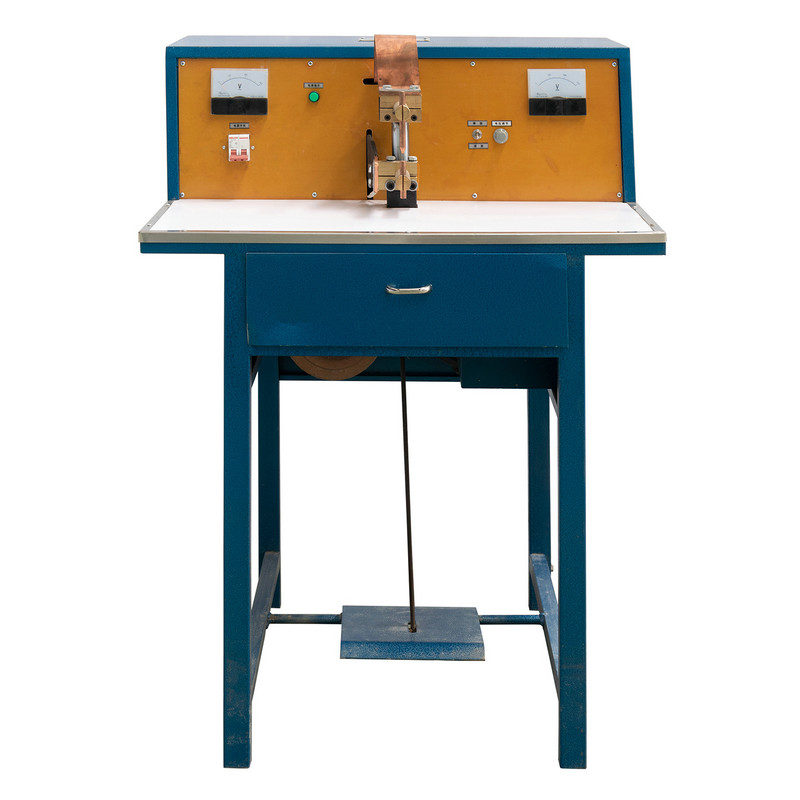
Desktop spot welding machines equipped with foot pedals represent a significant improvement in usability for small-part welding, jewelry fabrication, battery pack assembly, and electronics manufacturing. The Easy-To-Operate Desktop Pedal Welding Machine exemplifies this category: a compact, bench-mounted unit that combines programmable weld parameters with foot-pedal activation for ergonomic, repeatable welds.
| Parameter | Typical Value |
|---|---|
| Power input | 1.5 kW – 5 kW |
| Weld current range | 500A – 8,000A (peak) |
| Weld time adjustment | 1ms – 999ms |
| Electrode force | 20N – 200N |
| Applicable material thickness | 0.05mm – 3.0mm per sheet |
| Control interface | Digital panel + foot pedal |
Using a foot pedal effectively is a learnable skill. Follow these practical steps to get consistent results:
Usually caused by a worn potentiometer or dirty contact inside the pedal. Clean the potentiometer with electrical contact cleaner spray and test. If the problem persists, replace the potentiometer — a standard repair costing under $15 in parts.
Check the cable connector first; a loose or bent pin is the most common cause. Inspect the cable along its length for visible damage. On hall-effect pedals, check that the magnetic sensor has not been displaced by impact.
This typically means the pedal is being read as a binary on/off switch by the machine, not as a variable input. Verify that the machine's control board is set to "remote amperage control" mode, not "remote on/off" mode — these require different pedal types and different wiring configurations.
Not all pedals are universal. A 6-pin vs. 7-pin connector mismatch is one of the most common causes of pedal malfunction when switching pedals between machines. Always verify connector type and pin-out before purchasing a replacement pedal.
A foot pedal is not always necessary — but in the following situations, it is strongly recommended:
For thick-plate MIG or stick welding where heat input is less sensitive, a foot pedal adds little benefit and is generally not used.
Not all machines support external foot pedals. The machine must have a remote amperage control port (typically a 6-pin or 7-pin socket on TIG machines, or a dedicated control input on resistance welders). Check your machine's specifications before purchasing a pedal.
Generally no. MIG welding uses a trigger on the gun for arc start/stop, and wire feed speed is preset. Foot pedals are rarely used in standard MIG applications.
A quality pedal with a hall-effect sensor can last 500,000+ activations. Potentiometer-based pedals typically last 100,000–200,000 cycles before the resistive element wears and requires replacement.
Both control amperage remotely, but a foot pedal frees both hands for torch and filler rod control. A hand remote (thumb wheel or rocker on the torch) allows current adjustment without a separate floor unit, which is useful when welding in positions where floor pedal use is impractical.
Yes. By freeing both hands for electrode positioning and part holding, foot pedal activation directly improves electrode placement accuracy, which is a primary variable in spot weld nugget size and consistency.
Most desktop pedal spot welders handle mild steel, stainless steel, nickel strips, and copper-clad laminates in single-sheet thicknesses from 0.05mm to approximately 3mm. Always verify the specific machine's rated capacity for the material and thickness combination.
Often not. Connector types, pin configurations, and signal protocols vary by manufacturer. Universal aftermarket pedals exist for common connector standards, but always verify electrical compatibility before use.
Recommended Products

Product
Contact Info.
+86-152-5712-5882
Fax: +86-563-2269966
No. 21 Guangping Road, Guangde Economic Development Zone, Guangde City, Anhui Province
QR Code