Language
 English
 русский
 Español

Get A Quote
Get A Quote
 Home / News / Industry News / What is the difference between flash butt welding and resistance butt welding?
 2026.04.23
 Industry News
Butt welding is a core pressure welding process that connects two workpieces by applying axial pressure after heating the butt joint surfaces to a plastic state. It is widely used in metal processing, construction, hardware manufacturing, and electrical industries due to its high efficiency, stable quality, and environmental-friendly characteristics. Flash butt welding and resistance butt welding are the two most representative types of butt welding, sharing the same basic principle of resistance heating but differing significantly in heating methods, process flows, application scenarios, and matching equipment.
Resistance butt welding, also known as upset butt welding, is the earliest developed and simplest form of butt welding. The process involves clamping two workpieces firmly, making their end surfaces in close contact, switching on the welding current, and heating the contact area through contact resistance until the metal reaches a plastic melting state. Then, a sudden axial upsetting force is applied to complete the welding connection. This process has no spark splashing during operation, featuring low noise and stable operation.
Flash butt welding is an improved and upgraded process based on resistance butt welding. It requires a small initial gap between the two workpiece end surfaces. When the current is connected, the contact points generate high-temperature sparks (flash) through instantaneous short-circuiting, rapidly heating the workpiece ends while expelling oxides and impurities. After sufficient heating, the upsetting force is applied to form a high-strength welded joint. The flash effect not only heats the workpiece but also automatically cleans the welding surface, greatly improving joint quality.
Resistance butt welding is positioned as a low-cost, easy-to-operate welding solution, suitable for small-sized, low-precision metal workpiece connections. Its core characteristics include full contact between workpiece ends during heating, no flash splashing, low power consumption per unit area, and simple equipment structure. It is highly compatible with manual and foot-operated control modes, making it the preferred process for small and medium-sized enterprises with low-volume production.
The welding temperature of resistance butt welding is generally controlled between 1000°C and 1200°C, suitable for most carbon steel, copper, aluminum, and their alloy materials with small cross-sections. The entire process can be completed in 0.5 to 3 seconds, with extremely high production efficiency. The welded joint has uniform deformation, no obvious flash, and requires almost no post-welding treatment, reducing overall production costs.
Flash butt welding is positioned as a high-precision, high-strength welding solution, suitable for large cross-section, high-strength, and high-quality requirement workpieces. Its core characteristic is the flash generated by short-circuiting, which can effectively remove oxide scales, oil stains, and other impurities on the workpiece surface, eliminating the influence of surface defects on welding strength. The welding temperature can reach 1300°C to 1500°C, meeting the welding needs of high-carbon steel, alloy steel, and other difficult-to-weld materials.
Flash butt welding requires higher equipment power and control accuracy, with a process time of 1 to 5 seconds depending on the workpiece cross-section. The welded joint has a tensile strength close to the base metal, with excellent toughness and fatigue resistance, meeting the standards of load-bearing components in construction, machinery, and transportation industries. Although it generates a small amount of flash and noise, the comprehensive performance of the joint is far superior to resistance butt welding.
The process flow is the most significant difference between flash butt welding and resistance butt welding, directly determining equipment configuration, operation difficulty, and welding quality. For B2B buyers, understanding the complete process flow is crucial to selecting the right welding process and matching equipment, ensuring production efficiency and product qualification rates.
The entire resistance butt welding process is simple and easy to learn, with no complex parameter adjustment. Operators can master the operation skills after short-term training. It is especially suitable for matching with Foot-Operated Hand Operated Butt Welding Machine, which realizes manual clamping and foot-operated power control, reducing equipment investment and labor costs.
Flash butt welding has more complex process steps and requires precise control of flash time, upsetting pressure, and initial gap. It is suitable for automated or semi-automated equipment with high power configuration. The process has a self-cleaning function, which reduces the requirements for workpiece surface pretreatment and improves the stability of batch welding quality.
| Parameter Item | Resistance Butt Welding | Flash Butt Welding |
| Workpiece Contact State | Full contact, no gap | Initial gap 0.5-2mm |
| Heating Temperature | 1000-1200°C | 1300-1500°C |
| Upsetting Pressure | Low, 5-15MPa | High, 15-40MPa |
| Process Time | 0.5-3s | 1-5s |
| Surface Pretreatment | High requirements | Low requirements |
| Post-welding Treatment | Almost none | Remove flash burrs |
Material adaptability is a core factor for B2B buyers to choose welding processes, which directly affects the scope of application and production compatibility of equipment. Different metal materials have different thermal conductivity, melting point, and plastic deformation ability, so the matching welding processes are also different. Clarifying the material adaptability of the two processes can avoid welding defects such as incomplete fusion, cracks, and brittle joints.
Resistance butt welding is suitable for metal materials with good thermal conductivity, low melting point, and small cross-sectional area. Due to its low heating temperature and no self-cleaning function, it has high requirements for material purity and surface quality. The applicable materials and specifications are as follows:
Resistance butt welding is not suitable for high-carbon steel, stainless steel, and other materials with high hardness and poor thermal conductivity, as it is prone to incomplete heating and joint brittleness. It is the best match for Foot-Operated Hand Operated Butt Welding Machine, which can meet the welding needs of small-specification materials in daily hardware, electrical, and handicraft industries.
Flash butt welding has strong material adaptability due to its high heating temperature and self-cleaning function, covering almost all commonly used metal materials, especially suitable for large cross-section and difficult-to-weld materials. The applicable materials and specifications are as follows:
Flash butt welding can effectively remove oxides on the material surface, solving the welding difficulty of high-carbon steel and stainless steel. The welded joint has strength close to the base metal, meeting the performance requirements of mechanical structural parts. It is widely used in construction, automobile, railway, and electrical equipment manufacturing industries with high-quality standards.
Resistance butt welding is oriented to small-specification, common metal materials with low cost and simple operation; flash butt welding is oriented to large-specification, difficult-to-weld, and dissimilar metal materials with high joint strength and wide application range. B2B buyers can select the corresponding process and equipment according to the material type and cross-sectional area of their own products to maximize production benefits.
Equipment matching is the core link connecting welding process and actual production. Foot-Operated Hand Operated Butt Welding Machine is a universal, low-cost, and high-flexibility welding equipment, which is highly compatible with resistance butt welding process and widely used in small and medium-sized manufacturing enterprises. This section focuses on the structural characteristics, performance parameters, and application advantages of this equipment to provide reference for B2B buyers' procurement decisions.
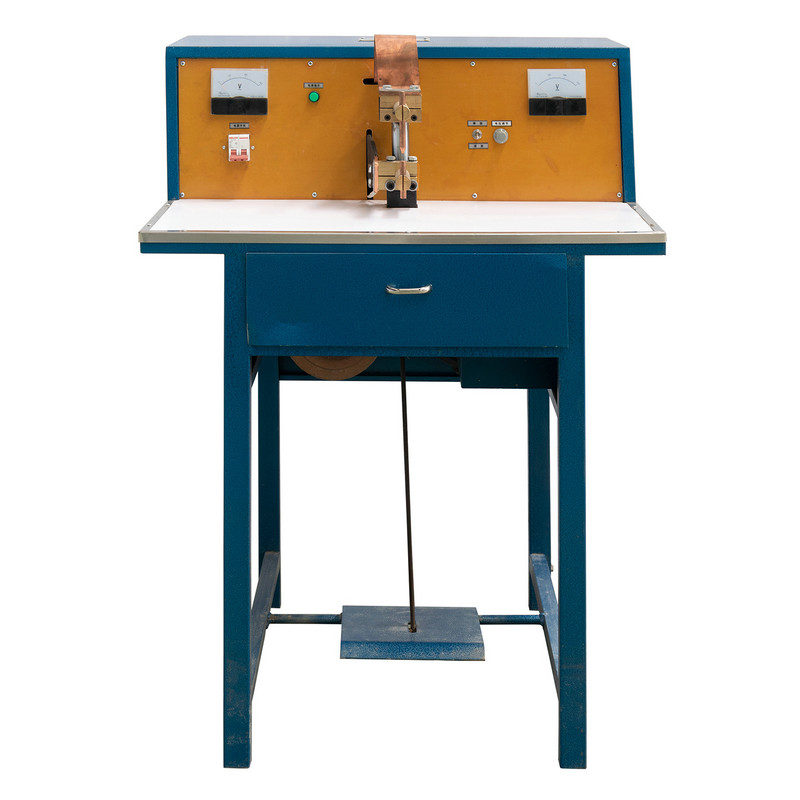
The Foot-Operated Hand Operated Butt Welding Machine adopts an integrated mechanical structure, consisting of a frame, clamping mechanism, transformer, control system, and foot-operated switch. The manual clamping mechanism is easy to adjust, suitable for workpieces of different shapes and sizes; the foot-operated switch realizes one-key power control, freeing both hands and improving operation efficiency. The equipment has a compact structure, small floor space, and can be placed in a narrow production space, suitable for multi-variety and small-batch production.
The welding transformer of the equipment adopts a full-copper high-efficiency design, with a power of 25KW, stable output, low energy consumption, and long service life. The clamping jaw is made of high-hardness alloy material, with strong wear resistance and good conductivity, ensuring stable clamping and consistent welding quality. The equipment is equipped with an over-current and over-temperature protection device, which automatically cuts off the power supply when abnormal, ensuring the safety of operators and equipment.
For B2B buyers in hardware, electrical, handicraft, and small steel processing industries, the Foot-Operated Hand Operated Butt Welding Machine has unparalleled advantages. First, the equipment investment cost is low, only 1/3 of automated welding equipment, reducing the initial financial pressure of enterprises. Second, the operation is simple, no professional welder is required, and ordinary workers can operate after 1-hour training, reducing labor costs.
Third, the equipment has strong flexibility, can quickly switch workpiece specifications, suitable for multi-variety and small-batch production modes, meeting the diversified needs of customers. Fourth, the maintenance cost is low, the structure is simple, vulnerable parts are easy to replace, and the daily maintenance only needs regular cleaning and lubrication. Fifth, the welding quality is stable, the joint qualification rate is over 98%, meeting the quality standards of industrial products.
This equipment is specially designed for resistance butt welding, perfectly matching the process characteristics of low pressure, short time, and full contact. It can realize high-quality welding of small-specification steel, copper, aluminum, and other materials, and is an essential production equipment for small and medium-sized manufacturing enterprises.
Welding quality directly determines the service life and safety of products, which is the primary consideration for B2B buyers. The quality differences between flash butt welding and resistance butt welding are mainly reflected in joint appearance, tensile strength, toughness, fatigue resistance, and defect rate. This section makes a comprehensive comparison from the perspective of industrial application standards to help buyers make accurate choices.
Resistance butt welding joints have a smooth surface, uniform deformation, no flash splashing, and no burrs. The joint width is slightly larger than the base metal, with a beautiful appearance, and no post-welding treatment is required. It is suitable for products with high appearance requirements such as handicrafts, decorative parts, and daily hardware.
Flash butt welding joints have a small amount of flash burrs due to the high-pressure upsetting process, which needs simple grinding treatment. However, the joint is dense, no pores, cracks, and other internal defects, and the appearance quality can meet the standard after treatment. It is suitable for industrial structural parts with high internal quality requirements.
The tensile strength of resistance butt welding joints is 70%-90% of the base metal, with good plasticity but low fatigue resistance. It is suitable for non-load-bearing components or low-load working conditions. The joint has no brittle structure, good impact resistance, and is not easy to break under low-stress use.
The tensile strength of flash butt welding joints is 90%-100% of the base metal, reaching the level of the base metal, with excellent toughness and fatigue resistance. It can withstand long-term vibration, impact, and high-load effects, meeting the use requirements of automobile, railway, construction, and other high-strength structural parts.
The defect rate of resistance butt welding is 1%-3%, mainly including incomplete fusion and loose joints, which are mostly caused by unqualified workpiece surface pretreatment or improper parameter adjustment. The process stability is high, and the defect rate can be controlled below 1% after standardized operation.
The defect rate of flash butt welding is below 0.5%, with almost no serious defects such as cracks and incomplete fusion. The self-cleaning function of the flash reduces the impact of surface impurities, and the batch welding stability is extremely high, suitable for large-scale industrial production with high-quality requirements.
If you produce daily hardware, decorative parts, electrical connectors, and other products with low load and high appearance requirements, resistance butt welding equipped with Foot-Operated Hand Operated Butt Welding Machine can fully meet the demand, with lower cost and higher efficiency. If you produce structural parts, auto parts, railway accessories, and other products with high strength and safety requirements, flash butt welding is the only choice to ensure product qualification rate and service life.
The application scenario is the direct basis for B2B buyers to select welding processes and equipment. Flash butt welding and resistance butt welding have clear division of labor in industrial applications, covering different industries and product types. Understanding their application scenarios can help buyers accurately match production needs and avoid equipment mismatch.
Resistance butt welding is widely used in small and medium-sized manufacturing industries with small-specification metal workpiece welding as the core process, and its main application scenarios include:
In these scenarios, the Foot-Operated Hand Operated Butt Welding Machine shows great advantages, with flexible operation, high efficiency, and low cost, helping enterprises reduce production costs and improve market competitiveness. A single equipment can meet the production needs of 5-10 workers, and the daily output can reach 8000-10000 pieces.
Flash butt welding is widely used in large-scale manufacturing industries with high-strength structural part welding as the core process, and its main application scenarios include:
In these scenarios, flash butt welding can provide high-strength, high-reliability welded joints, ensuring the safety and service life of products. It is usually matched with semi-automated or automated equipment to meet the needs of large-scale and standardized production.
Small and medium-sized enterprises engaged in small hardware, electrical, and handicraft production should choose resistance butt welding and supporting Foot-Operated Hand Operated Butt Welding Machine; large enterprises engaged in construction, automobile, and machinery manufacturing should choose flash butt welding and automated equipment. Correct process and equipment matching can maximize production efficiency and product quality.
Cost control is the core concern of B2B buyers in equipment procurement. The cost difference between flash butt welding and resistance butt welding involves equipment investment, energy consumption, labor, maintenance, and post-welding treatment. This section conducts a comprehensive cost analysis to help buyers calculate the overall investment and return cycle.
The Foot-Operated Hand Operated Butt Welding Machine for resistance butt welding has a low investment cost, with a market price of 800-1500 US dollars per unit, compact structure, and no need for additional auxiliary equipment. It is suitable for start-ups and small and medium-sized enterprises with limited initial investment.
Flash butt welding equipment requires higher power and control system, with a market price of 3000-10000 US dollars per unit, and needs supporting flash collection and post-welding treatment equipment, with a total investment of 3-10 times that of resistance butt welding equipment, suitable for large enterprises with sufficient funds and large-scale production.
The energy consumption of resistance butt welding is low, with an hourly power consumption of 2-3 degrees, and the labor cost is low, with no need for professional operators. The maintenance cost is extremely low, with only regular replacement of clamping jaws, and the annual maintenance cost is less than 100 US dollars. The post-welding treatment cost is zero, and the workpiece can be directly packaged after welding.
The energy consumption of flash butt welding is high, with an hourly power consumption of 5-15 degrees, requiring professional operators to adjust parameters. The maintenance cost is high, including transformer maintenance, control system calibration, etc., with an annual maintenance cost of 300-500 US dollars. The post-welding treatment needs to remove flash burrs, increasing the labor and grinding material costs by 0.01-0.05 US dollars per workpiece.
Recommended Products

Product
Contact Info.
+86-152-5712-5882
Fax: +86-563-2269966
No. 21 Guangping Road, Guangde Economic Development Zone, Guangde City, Anhui Province
QR Code