Language
 English
 русский
 Español

Get A Quote
Get A Quote
 Home / News / Industry News / Welding Machine Definition: Types, Specs, and Selection Guide for Industrial Buyers
 2026.10.01
 Industry News
Your sheet metal line is producing inconsistent welds. It may not be the operator's technique. More often, the machine was never matched to the actual job. Before replacing anything, it helps to start with a precise definition.
A welding machine is a device that joins metal workpieces by applying heat, pressure, or both to form a permanent bond. That definition covers everything from a 5 kVA desktop spot welder to a 200 kW flash butt welder. The difference lies in how heat is generated, how much force is applied, and how precisely the process is controlled.
A welding machine is a power-and-control system that creates a permanent joint between metal parts. It delivers electrical current, mechanical force, and precise timing to a defined spot on the workpiece. In resistance welding, the process used in spot, butt, and seam welding, no filler metal is added. The transformer lowers voltage and raises current. That current passes through the electrodes and the workpieces, and the contact resistance at the junction generates enough heat to melt a small nugget. Electrode pressure holds the parts together while the nugget solidifies.
The machine is more than a power source. It includes the transformer, welding controller, electrodes, cooling system, and the mechanical or pneumatic cylinder that applies force. Every part works as one system. A weak transformer will not deliver current. A slow controller will not hold the heat. A cooling failure will destroy electrodes quickly.
The process has five steps. First, electrodes clamp the sheets under controlled force. Second, a high current is applied for a precise number of cycles, normally 5 to 18 cycles on a 50 Hz supply. Third, the contact resistance between the electrode and the sheet heats the metal rapidly. Fourth, a molten nugget forms in the middle while the surrounding metal stays solid. Fifth, the current stops and the nugget cools under pressure.
Four parameters matter most: welding current, weld time, electrode force, and electrode tip size. Higher current produces a hotter weld. More time creates a larger but riskier nugget. More force lowers contact resistance and gives a denser weld. Smaller tips increase current density.
| Steel Thickness | Welding Current | Weld Time | Electrode Force |
|---|---|---|---|
| 0.5 mm | 4-6 kA | 5-8 cycles | 1.0-1.5 kN |
| 1.0 mm | 7-10 kA | 8-12 cycles | 2.0-2.5 kN |
| 1.5 mm | 10-14 kA | 12-15 cycles | 3.0-3.5 kN |
| 2.0 mm | 14-18 kA | 15-18 cycles | 4.0-5.0 kN |
Key point: Spec-sheet figures are a starting point. The final settings always depend on the actual material, coating, and electrode condition.
The right machine is defined by the joint you need to make. Here are the types you will most often evaluate when sourcing industrial welding equipment.
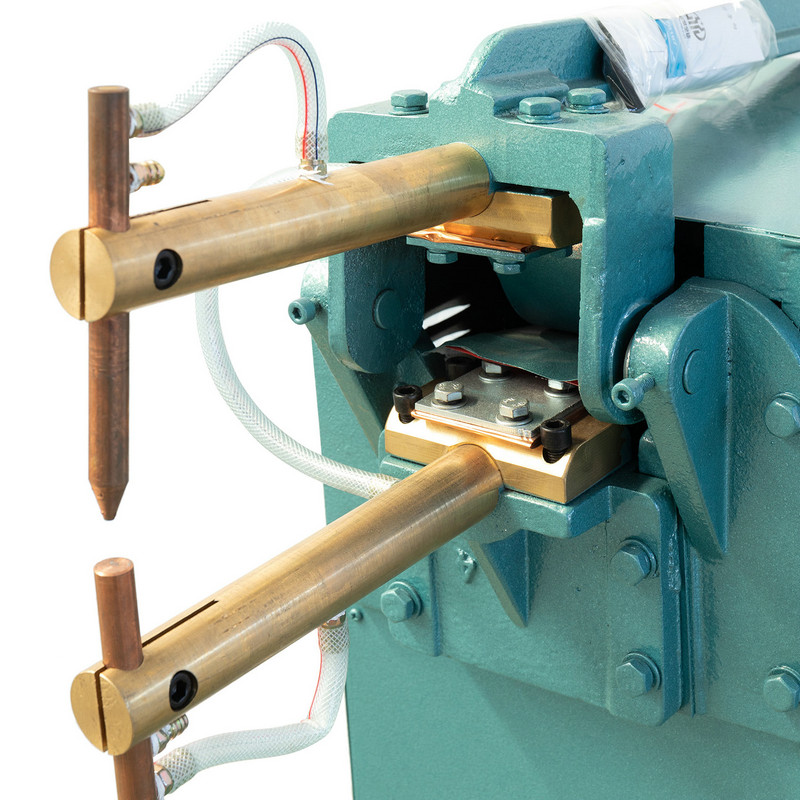
Spot welding is the most common resistance process for sheet metal. Two electrodes reach the opposing faces of the joint, and a single weld nugget forms at the contact point. Typical parts include enclosures, automotive components, brackets, shelves, and ventilation ducts.
Spot welding machines are classified by how force is applied. Foot-pedal models are manual and suited to repair work and small batches. Pneumatic models use an air cylinder for faster, more consistent force, which makes them the right choice for production lines. Desktop and handheld versions cover small parts and field service.
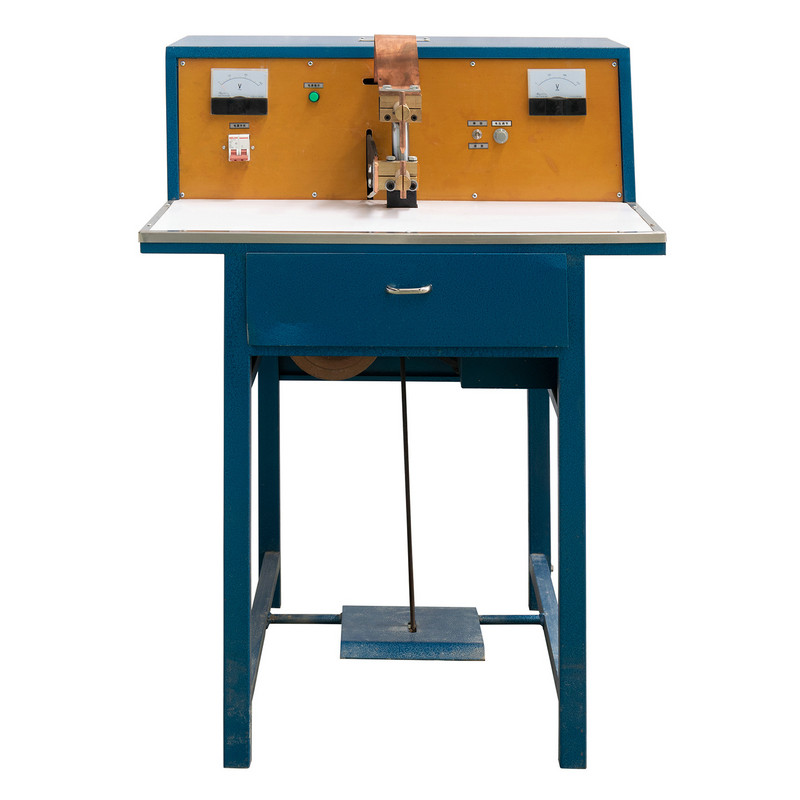
 DN1-16KW Metal Shell Gear Type AC Spot Welding MachineThis compact spot welder uses a thyristor non-contact switching circuit for fast, repeatable welding. Its low no-load current and light weight make it practical for repair work and small-batch production, as discussed in the context of manual foot-pedal machines.View Product →
For a practical look at how pedal-operated spot welders perform in everyday fabrication, see this article on DN pedal spot welding machines.
Butt welding joins two parts end to end. The parts are clamped, brought into contact, and current is sent through the interface. The resistance at the contact point heats the ends until they forge together. Common applications include wires, rods, chains, pipes, and rebar.
Manual butt welders handle smaller cross-sections. Pneumatic butt welders deliver higher clamping force and more consistent results. Flash butt welding is used for larger profiles: an arc melts the surfaces, then the parts are forged together.
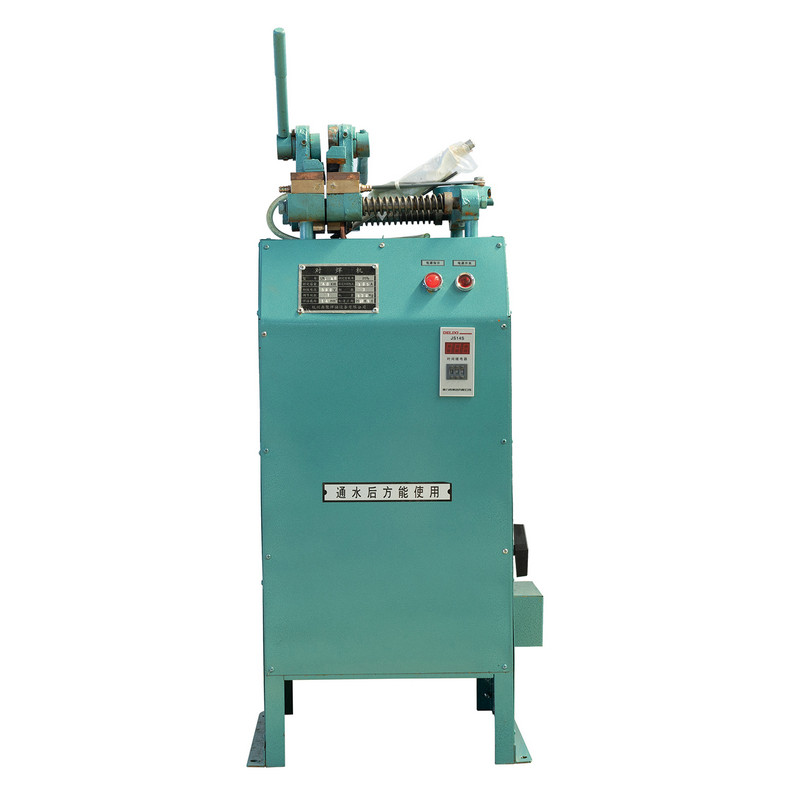
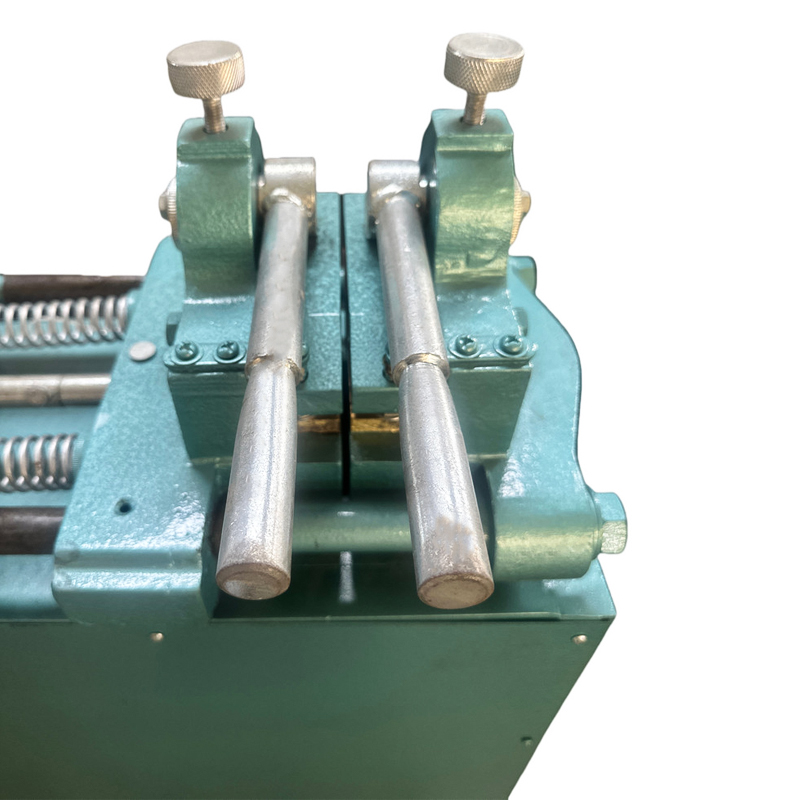 UN1-25KW Foot-Operated Hand Operated Butt Welding MachineThis butt welder handles low carbon steel and non-ferrous metals with stable AC contactor control. Foot or hand operation offers flexibility, fitting the manual butt welding category preceding seam welding applications.View Product →
Seam welding machines replace stationary electrodes with rotating wheels. Current is pulsed while the wheels roll over the metal, creating a continuous weld line. This process is used for fuel tanks, radiators, refrigerant tubes, and any part that must be liquid- or gas-tight.
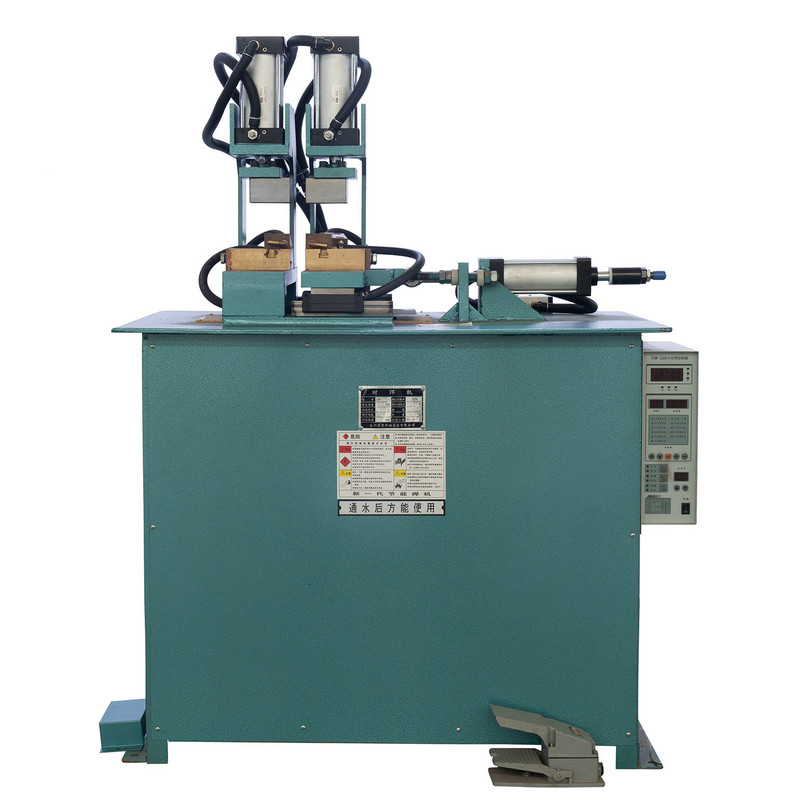
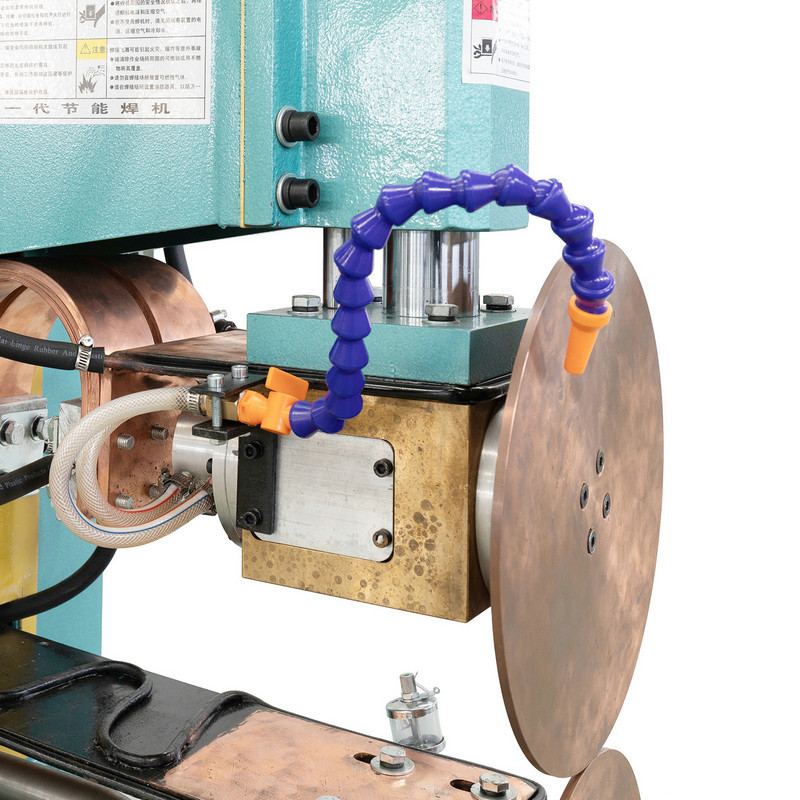 FN-100 Circumferential Seam Welding Pneumatic Seam WelderThis pneumatic seam welder creates liquid-tight joints on sheet metal from 0.1mm to 2.5mm thick. Its three-phase stepless speed regulation and vertical or horizontal operation suit fuel tanks and radiators, as referenced in the seam welding section.View Product →
Stud welding machines weld a threaded stud or fastener to the base metal, which is common in steel panels and structural assembly. Energy-storage machines release stored electrical energy in a fraction of a second, making them ideal for thin stainless steel, aluminum, and precision components where heat input must be minimized. Mid-frequency and variable-frequency machines use inverter technology to control current with high speed, improving weld quality on coated metals and high-output lines.
When comparing spec sheets, three numbers tell most of the story: rated power, duty cycle, and welding current. A higher number is not always better. A 100 kVA machine at 20% duty cycle can be less productive than a 50 kVA machine at 50% duty cycle.
Rated power is the transformer capacity. Spot welders are rated in kVA, butt welders in kW. More power allows thicker material, but also demands heavier supply cables and better cooling.
Duty cycle is rated over a 10-minute period. A 50% duty cycle means 5 minutes of full-current welding and 5 minutes of rest. Continuous lines need either a higher duty cycle or a chiller.
Welding current is measured in kA. Current density determines whether the weld forms. Larger electrode tips need more current to reach the same density.
Transformer quality matters for long runs. All-copper coils run cooler and last longer than aluminum coils, especially when a machine runs at high duty cycle or feeds a robotic arm.
| Machine Type | Typical Power | Operation | Best For |
|---|---|---|---|
| Pedal Spot | 5-35 kVA | Manual | Repair, batch work |
| Pneumatic Spot | 25-150 kVA | Semi-automatic | Volume sheet metal |
| Butt | 1-200 kW | Manual / pneumatic | Wires, rods, bars |
| Seam | 50-150 kVA | Automatic feed | Sealed joints |
| Energy Storage | 200-3000 J | Manual / pneumatic | Thin, precision parts |
Start with your dominant weld pattern and work backwards. If 80% of your work is sheet metal spot welding, buy a spot welder and outsource the butt welding. A machine that covers everything usually does nothing well.
We have a detailed article on choosing the right industrial spot welding machine. It walks through material, output, and budget considerations in real production settings: How to choose the right industrial spot welding machine.
Electrode wear and controller drift cause most quality problems. Dress the tips on a fixed schedule, check timing with a weld checker, and keep air pressure and electrical connections clean. For long production runs, a chiller is not a luxury; it is what keeps the transformer from overheating.
AC spot welding is the traditional approach. It is reliable and handles most carbon steel. DC spot welding, achieved with mid-frequency or variable-frequency inverters, offers much faster current control. That makes it better for aluminum, galvanized steel, and multi-layer stacks. DC also reduces heat input and electrode wear.
A 5 kVA machine can make clean welds on 0.5-0.8 mm mild steel. A 16 kVA machine works well on 1.0-1.5 mm. A 35 kVA machine handles 2-3 mm steel when the electrode force and tip size are correct. Thicker material needs more current and more mechanical force.
Duty cycle is the percentage of a 10-minute period that the machine can weld at its rated current. A 50% duty cycle means 5 minutes of welding and 5 minutes of cooling. Push beyond that and the transformer and cables overheat, triggering the protection circuit.
If you take frequent breaks, a chiller might be optional. If you weld continuously for hours, it is essential. The chiller removes heat from the transformer and water-cooled electrodes. Without it, you risk stuck electrodes and transformer insulation failure.
Stationary machines give more electrode force, which matters for thicker material. Handheld machines add mobility and are often used for repair and field work. Choose based on where the work actually happens most often.
A welding machine is a tool for making one defined joint, repeatedly and reliably. Whether you need a pedal spot welder for light sheet metal, a pneumatic machine for high volume, a butt welder for rods, or a seam welder for sealed tanks, the starting point is always the same: define your material, your joint, and your production tempo.
If you are not sure which type matches your work, ask the manufacturer for help with selecting the parameters. A good supplier will walk through your material, weld schedule, and expected output before quoting a price.
Recommended Products

Product
Contact Info.
+86-152-5712-5882
Fax: +86-563-2269966
No. 21 Guangping Road, Guangde Economic Development Zone, Guangde City, Anhui Province
QR Code